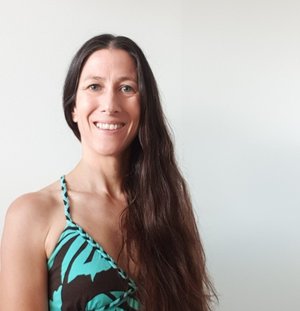
Charting a course for knowledge: Celebrating Day of the Seafarer with Lisa Blair
When Lisa Blair completed her solo, nonstop, and unassisted sail around Antarctica in 2022, not only did she become the fastest person ever to do so, but she also collected a wealth of data about the ocean, microplastics, the weather, and the seabed.
From hostess to sailor
Blair, who now holds multiple sailing records, didn’t always plan on being a sailor. “I had a summer holiday from university when I was 25, and I got this job as a host on a charter boat in the Whitsundays that was meant to be a three-month summer job. I just fell in love with sailing.”
That summer job became a year-long position, followed by sailing from Samoa to Hawai’i with a university friend and her father. “It was my first ocean crossing. I’d never made an overnight sailing trip before, never really helmed a boat before, or done any of that stuff. We sailed this little 40-foot sailboat across from Samoa to Hawaii for three months, and it was just the most unreal adventure,” says Blair.
Sailing had sedimented itself into Blair’s heart. She read books about solo sailors such as Kay Cottee - the first woman to complete a solo, nonstop, unassisted circumnavigation of the world in 1988. Blair was inspired to raise funds to enter yacht races and eventually take up solo sailing.
From sailor to citizen scientist
Take even the briefest glance at Blair’s yacht, and you’ll know that sailing isn’t the only thing close to her heart. Named Climate Action Now, the entire hull of the vessel is wrapped in Post-it notes containing “messages from people I’ve met, talked to, or seen the boat. Each message is an environmental action on something they’re already doing towards a better future,” Blair explains. Many of these actions are small – taking shorter showers, picking up rubbish when walking the dog, and so forth. “It’s about changing the mindset of the individual from this alarmist, ‘it’s so big a problem that my bit’s never going to help’ to showing people that as an individual, if you have a million people creating change, doing all of these small actions, you are contributing to a larger impact.”
When it came to the 2022 Antarctica challenge, “it was important for me that the project has more of an outcome than it just being a sailor doing a project, that had something that’s giving back to our communities,” says Blair. Since that sail, she has engaged with schools, communities, and sailing groups on climate action and, of course, sailing itself.
Inspiring and engaging with people wasn’t the only environmental action Blair wanted the Antarctica project to bring about. “I already knew the Southern Ocean is such a data-sparse region, and it’s so vital to our understanding of climate change and the health of our oceans,” says Blair. “If I’m going to be on a boat for three months in the Southern Ocean, what can I do that’s going to be useful?”
Conversations with scientists led to Climate Action Now being fitted with various instruments. Alongside microplastic and dissolved carbon dioxide, salinity, chlorophyll, and bio-optic samplers for Australia’s Integrated Marine Observing System (IMOS) program, and meteorological sensors, drifter, and buoys for the Australian Bureau of Meteorology, Climate Action Now also had a data logger, which quietly collected depth information for Seabed 2030.
“The data logger was easy to install, and once we got it going, it was a set-and-forget,” says Blair, noting that ease of use is essential on these types of sails as “99% of the time you’re operating on your maximum level of exhaustion… you have to weigh up what you can and can’t do.”
A surprising knowledge gap
When Blair learned about Seabed 2030 and the need for seabed data, she was surprised. “I guess I had assumed because I’ve got paper charts, with depth soundings listed on the paper chart that seemed to be pretty well everywhere. I had assumed that we had mapped more than we actually have,” she explains. “It took some explaining from the Seabed 2030 crew to really make me understand how valuable that data is for things like early forecasting systems and understanding climate change and the effects of the seabed on sea level rise.”
Particularly interesting for Blair was learning about how important seabed data is for tsunami warning systems. “If we don’t know the shape of the sea floor, we can’t predict how a tsunami wave is going to form, we can’t predict where it will land, and therefore, we can’t notify those communities and give them adequate warning.”
More sailing – and more data collection
Blair is already planning her next sailing projects. For this year, “I’m in the sponsorship-seeking phase for a sail-a-speed record from Sydney, Australia, to Auckland, New Zealand, and then do a secondary record around New Zealand,” says Blair, who is also planning on engaging with schools in New Zealand to talk about the ocean, climate action, and the results of the data she has been collecting.
Also in the works is an Arctic Circle sail. “I intend to try and become the first person in the world to sail solo, nonstop, and unassisted around the Arctic Circle. It’s never been done before. It’s only possible now because of climate change.” Not one to shy away from challenges, Blair is hoping to do the sailing in a yacht created out of volcanic fibre. “A fibreglass boat generally has a lifespan of around 30 years, so all of the boats built 30 years ago are starting to end up in landfills…volcanic fibre, which is basically basalt rock, is ten times stronger than fibreglass, only 15% more expensive, and it has a lower environmental impact.” In addition, Blair will also be continuing the Post-it Note campaign and other engagement work and will continue as a citizen scientist. “It would be great to get a replica set of data from the Arctic [to compare to the Antarctic data],” Blair says.
Blair also encourages other sailors to get involved in collecting seabed data. “This is a really cool program that anyone can get involved in. All you have to do is register on the [Seabed 2030] website, and they’ll send you the right data logger for your boat.”
This story was written for Seabed 2030