Three things you (possibly) didn't know about Hawaiian bobtail squid
As if this little critter wasn’t cute enough, bobtail squids are also known as dumpling squids or stubby squids (awe). As you can see from the scale in the photo, they are small too! Adult Hawaiian bobtails only reach 3 centimetres in mantle length (that’s the main body of the squid).
There are around 70 species of bobtail squid known to science. They are found in the Pacific, Indian, and Atlantic Oceans, where they happily munch on shrimp, fish and annelids (think sea worms) before taking a nap, buried in the sand. This particular species of bobtail, however, lives in the coastal waters around Hawai’i and Midway Island.
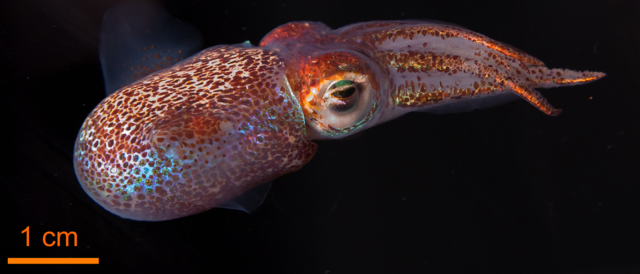
Credit: Margaret McFall-Ngai (CC BY 4.0)
Curious to know more? Here are three things that you (possibly) didn’t know about Hawaiian bobtail squids
1: They only live for ten months… probably less
Just a couple of months after these tiny squid hatch, they’re ready to start making their own babies. Hawaiian bobtails only breed once. The males die pretty quickly after spawning. The females live slightly longer, just enough time to deposit their eggs somewhere safe (normally a crevice).
2: They have a glowing partnership with the marine bacterium Vibrio fischeri
Hawaiian bobtail squids actually glow! Well, technically, it’s not the squid that’s glowing, but it’s the bioluminescent bacteria Vibrio fischeri. The squids have a light organ that is the perfect home to this particular bacteria. If other bacteria tried to live in the organ, they would die! The squid can modify the intensity of the bioluminescence to suit its need. Every morning at dawn, the squid “vent” around 95% of their bacterial buddies.
3: Their eggs are protected with antifungal coating
Leave anything sitting in the sea, and things will start to grow on it. Turns out Hawaiian bobtail squids have a nifty little trick to help keep this growth at bay. Squid eggs are encased in a ‘jelly coat’, which is covered in bacteria from the squid’s “accessory nidamental gland” (glands that secrete the eggs). Research has shown this protective layer is effective at keeping the likes of the pathogenic fungus Fusarium keratoplasticum and the yeast Candida albicans out of the eggs.