CRISPR biosensing platform makes ocean monitoring easier
Our oceans are under intense pressure from warming waters, pollution, and habitat loss, but new tools are emerging that could improve how we monitor the state of the ocean.
Take this portable, low-cost, CRISPR-based biosensing platform, for example. Developed by researchers at Harvard University and MIT, the device builds on diagnostic tools originally designed for human healthcare. Rather than, say, detecting pregnancy or diseases, this particular platform focuses on monitoring the DNA and RNA of “barometer species” - species that can offer early insight into changes in ocean health.
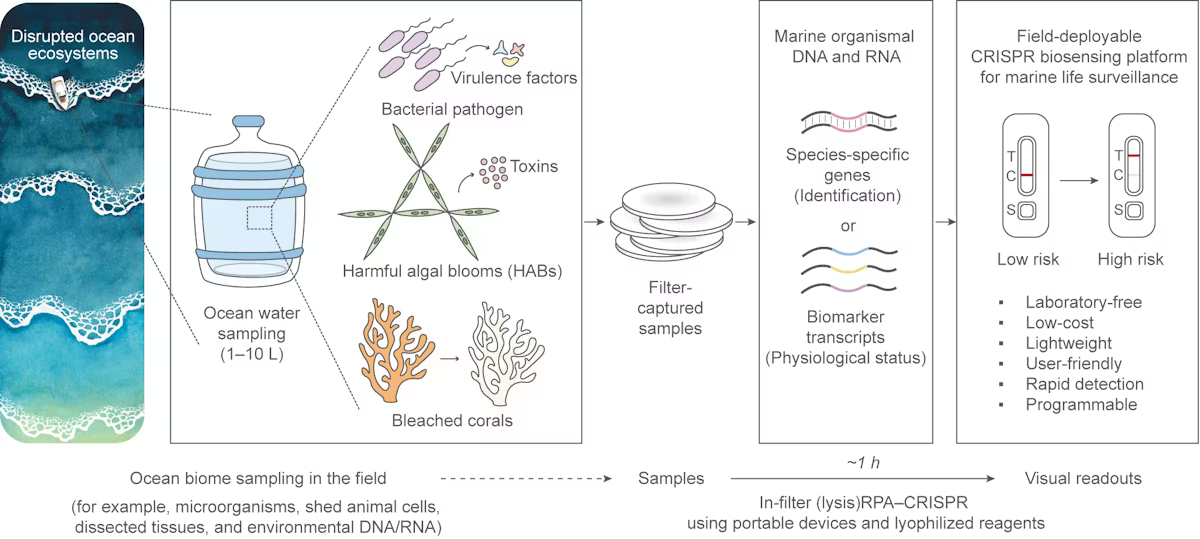
A portable CRISPR biosensing platform for the ocean. Credit Kin et al (2026)
The team tested the platform on three very different species linked to distinct marine risks: Vibrio bacteria, which can proliferate in warming waters and threaten both ecosystems and human health; Pseudo-nitzschia algae, known for producing toxins during harmful algal blooms; and a coral species whose genetic signals reveal early heat stress.
What’s pretty nifty about this platform is that the whole thing is portable. Samples are collected by passing seawater through simple filters that capture microbes or shed cells from larger organisms. Instead of sending those samples off to a lab, the filters are processed directly on site using a small, low-cost, 3D-printed device.
Inside the device, cells are broken open, and their DNA or RNA is amplified, before CRISPR is used to detect specific genetic sequences linked to particular species or, in the case of the coral, stress responses. If a targeted species is present, the result appears as a visible line on a paper test strip.
According to the researchers, the entire process takes less than an hour and doesn’t rely on specialist equipment or laboratory conditions. Reagents are shelf-stable, temperatures are maintained using simple heat sources, and results can be read by eye. The researchers say the platform can also be easily adapted to detect many more species.
Read the paper A field‑deployable CRISPR-based biosensing platform for monitoring marine ecosystems (paywalled)